“Give us grace, Almighty Father, so to pray, as to deserve to be heard, to address thee with our hearts, as with our lips.”
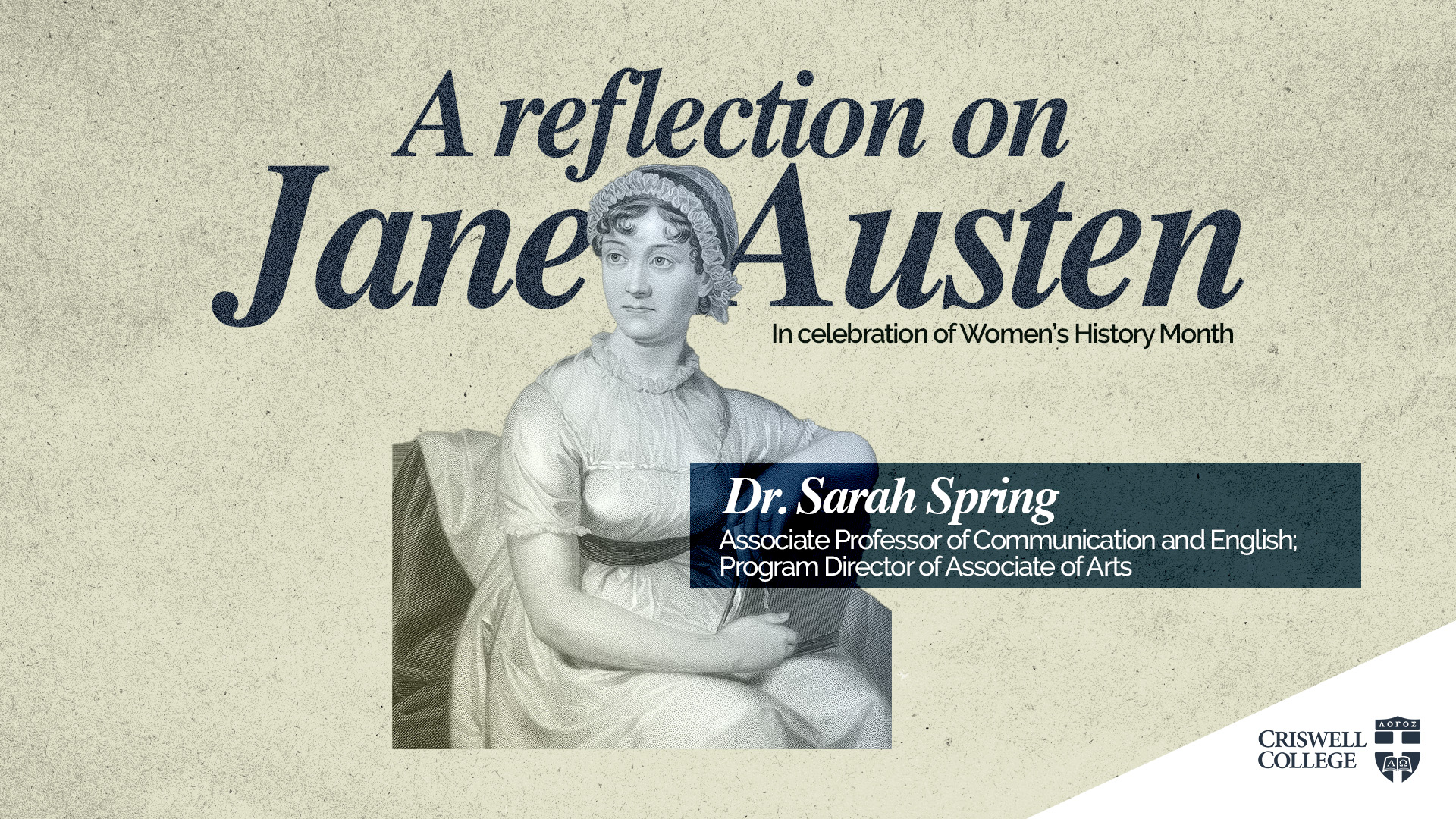
Jane Austen celebrated her 250th birthday in December, and in honor of Women’s History Month, I want to briefly remember her as a woman of faith whose relationship with God shaped her novels and continues to inspire us.
While not an evangelical (as we currently understand the word), Jane was raised in the Anglican church; her grandfather, father, and a few brothers were all Anglican rectors. The Austen family participated in the Church of England tradition of morning and evening prayers, and in addition to the Book of Common Prayer, Jane wrote her own devotions for these occasions. Only a few have survived, sadly, but an excerpt from one such remaining prayer was used to start these thoughts.
I am not a theologian nor an Anglican, but I find myself drawn to their ideas of a faith that quietly yet steadily grows through daily, holy habits. Jane Austen, as argued by many scholars, simply wanted her life to reflect her faith. This philosophy is likely shared by many of us at Criswell and beyond: our faith should be evident by the way we live rather than the way we talk.
The characters in Austen’s novels exhibit this same Christian worldview, although it is easy to focus on other themes and miss the reason for many of their actions. Elizabeth Bennett, for example, is “prejudiced” against Mr. Darcy for much of the novel, but she revises her opinion after serious reflection; the heroine of Northanger Abbey Catherine likewise has an epiphany that her reading habits are preventing her from a fully developed inner life. Further, in the first Jane Austen novel I ever read, Emma (title character and heroine) is chastised by Mr. Knightley after mean-spirited behavior to another female character who is of a lower social class, and Emma is forced to rethink her mindset and actions, which results in the maturing of her character – her inner musings also lead her to the realization that she is in love with Knightley.
All of these heroines showcase the importance of reflection, but more than that, their reflections lead to necessary change; this is an essential Christian idea and practice, so while God is rarely mentioned explicitly in Austen’s literature, I believe we can see Him throughout her work and her life (much like the book of Esther, perhaps?).
I’ve always argued that fiction can tell the truth in ways that nonfiction cannot, and as Women’s History Month comes to a close, I hope my words might inspire you to read Jane Austen with new appreciation or to perhaps pick up her novels for the first time. In her own words from that same prayer, “May we now, and on each return of night, consider how the past day has been spent by us …. Incline us to ask our hearts these questions oh! God.”
Full Jane Austen prayer mentioned: On Each Return of the Night: A Prayer by Jane Austen – Jane Austen articles and blog